Where to stay in Tokyo on a first trip: compare four hubs
Checked against 20 official sources. 14 minute read.
What to know first
Shortlist your first Tokyo base by your main rail journeys: Ueno or Nippori for Narita's Skyliner, Tokyo or Shinagawa for the Tokaido Shinkansen, and Shinjuku when its Narita Express connection and local routes suit your plans. Shinagawa is also worth checking for Haneda. Then choose by the walk from hotel to station and your daily destinations, and for early flights or late nights, check the whole journey both ways, including the final walk and hotel access.
Conditions to check
- Narita Express also serves Tokyo and Shinagawa. Check the train serving your station on your date rather than assuming every departure has the same destination.
- Skyliner uses Keisei-Ueno and Nippori. Identify the actual arrival station and hotel walk; a general “Ueno” label is not enough.
- For early flights or late evenings, check the whole journey in both directions, including the final walk and hotel access.
- Confirm room occupancy, required accessibility and luggage arrangements with the exact hotel. If several areas work, compare rooms, total prices and cancellation terms there.
- Narita → Tokyo, N’EX
- Fastest 53 min · ¥3,140
- Narita → Nippori, Skyliner
- About 36 min · ¥2,580
- Haneda T3 → Shinagawa, Keikyu
- 11 min · ¥330
On this page

Conditions that change the answer
- Best for
- Ideal for first-time visitors who want a single Tokyo accommodation base, but need to weigh the pros and cons of four key transit hubs.
- When it's not worth it
- You will still need to decide how many bases to use, whether to split your stay, or explore other regions, taking current hotel availability, rates, and guest reviews into account.
Choose by traveller type
- Decision order
- Pick one Tokyo base area, shortlist your target hotel neighborhoods, and compare them across the same six criteria.
- What maps cannot confirm
- A standard map overview cannot confirm your exact station exit, walking incline or stairs, dated service changes, final transfers, or hotel room and luggage storage availability.
What a hotel candidate means
Candidate does not mean booked, available, cheapest, fastest, quietest, safest or suitable for everyone.
Start only after choosing a single home base in Tokyo
The first-trip base guide covers open-jaw shape, base count, split stays and other regions. This page compares only exact catchments for one Tokyo base.
- Specify both airport terminals, travel dates, and acceptable arrival or departure time windows;
- list all scheduled, date-specific visits along with their precise entrances;
- set your limits for walking distance, train transfers, luggage, and early or late travel;
- include any Shinkansen or intercity train departures; and
- Account for hotel location, mobility, children, sensory needs, and luggage constraints across each step.
Compare four actual hotel neighborhoods, not just four isolated spots
“Tokyo,” “Ueno,” “Shinjuku” and “Shinagawa” are starting labels. The hotel side, station entrance and line you would use can change the route. Nippori is included with Ueno only as a possible Keisei airport connection, not as proof that every Ueno-area stay can use it.
Airport access is only one row. A direct named service cannot override fixed visits, the departure trip, station walking, luggage or a provider-owned late-arrival condition.
Arriving in the daytime with bags? See airport to your hotel: Narita, Haneda and Kansai for trains, buses and fixed-fare taxis from Narita, Haneda and Kansai.
Want to see a sumo tournament? See sumo tickets for the 2027 tournaments: January 2027 tickets go on sale on 5 December 2026.


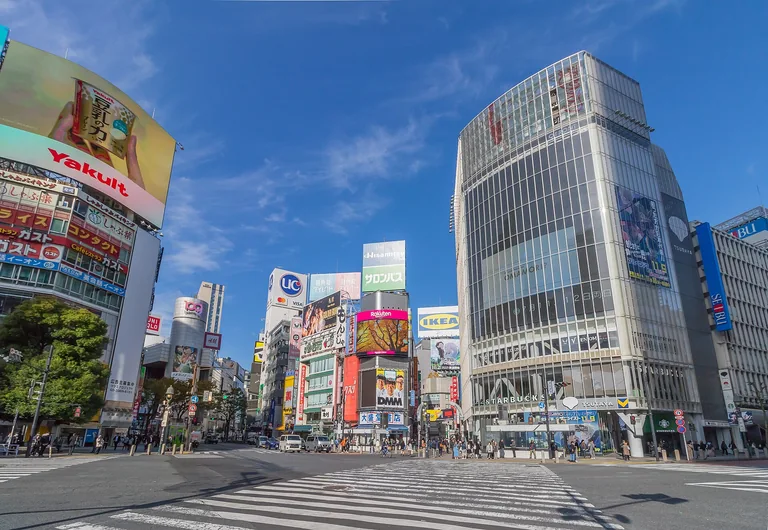
The south entrance of Shinjuku Station at dusk · 2024


The park entrance of Ueno Station · 2023


Kaminarimon Gate in Asakusa at night · 2023
Which Tokyo area?
If columns are cut off, scroll sideways. Keyboard: focus the table, then use Left/Right Arrow keys.
| If | Stay near, and why |
|---|---|
| You land at Narita and want the cheapest fast train | Stay near Ueno or Nippori: Skyliner to Keisei-Ueno about 41 min (Nippori 36 min), ¥2,580. |
| You land at Narita and leave Tokyo by Tokaido Shinkansen (Kyoto, Osaka) | Stay near Tokyo Station: N'EX 53–59 min, ¥3,140, and the Shinkansen from the same station. |
| You land at Haneda | Stay near Shinagawa: Keikyu 11 min from Terminal 3, ¥330, with the Tokaido Shinkansen at the same station. |
| Evenings, shopping and nightlife matter most, and you have one big bag or less | Stay in Shinjuku: N'EX from Narita about 86 min (¥3,330), or the Airport Limousine bus about 1 h 45 min (¥3,600). Tokyo Station is 14 min away (¥260) for the Shinkansen. |
| You're heading north or to the Japan Sea coast by Shinkansen (Sendai, Kanazawa) after Tokyo | Stay near Ueno or Tokyo Station. Tohoku and Hokuriku Shinkansen trains start at Tokyo and most stop at Ueno, but not all: on JR East's October 2026 weekday timetable, 4 of 113 Tohoku departures (for example Hayabusa 5 at 08:18) and 1 of 63 Hokuriku departures (Kagayaki 503 at 07:20) don't stop there, so check your train. |
| Early flight from Haneda | Stay near Shinagawa: the shortest airport ride here (11–14 min). The first Keikyu train leaves Shinagawa at 05:09 and reaches Haneda Terminal 3 at 05:27, weekdays and weekends. |
| Early flight from Narita | Stay near Ueno or Nippori, or Tokyo Station: the fastest direct trains. Check the first train for your date. |
Our judgement. Times and fares are from the operators (see the key facts).
Worked example: land at Narita, three nights in Tokyo, then Nozomi to Kyoto
One adult, Narita arrival, a morning Nozomi to Kyoto on Day 4. Times are on-board times.
If columns are cut off, scroll sideways. Keyboard: focus the table, then use Left/Right Arrow keys.
| Base | Arrival (Narita → hotel area) | Day 4 (hotel area → Nozomi) | Train cost for the two trips | Changes with luggage |
|---|---|---|---|---|
| Tokyo Station | N'EX 53–59 min · ¥3,140 | Board at Tokyo · 0 min | ¥3,140 | 0 |
| Ueno | Skyliner about 41 min · ¥2,580 | JR Ueno → Tokyo 5 min (¥200 if bought separately; a ticket to Kyoto issued for the Tokyo Ward Area adds no fare for this leg) | ¥2,580–2,780 | 1 |
| Shinagawa | N'EX about 68 min · ¥3,330 | Board at Shinagawa · 0 min | ¥3,330 | 0 |
| Shinjuku | N'EX about 86 min · ¥3,330 (or Limousine bus ¥3,600 to the hotel area) | JR Chuo Rapid to Tokyo 14 min (¥260), or Yamanote Line to Shinagawa 21 min (¥260) | ¥3,590 | 1 |
What it means: the four areas differ by about ¥1,000 at most across both trips, so price isn't the decider. Changes with luggage and time are: Tokyo Station and Shinagawa need no change of train with bags, Ueno is cheapest, and Shinjuku costs the most time (about an hour and a half on the N'EX).
If you land at Haneda instead: Shinagawa is 11–14 minutes by Keikyu (¥330), and Shinjuku 30–50 minutes via Shinagawa (¥590). Tokyo Station and Ueno need a change: Keikyu gives 20 minutes to Tokyo Station from Terminal 3 (23 from Terminals 1 and 2), and Haneda Airport gives about 30 minutes to Tokyo and about 40 to Ueno. By Tokyo Monorail and JR via Hamamatsucho, the through fare is ¥720 to Tokyo and ¥730 to Ueno (printed tickets), or ¥590 with the weekend and holiday Monorail & Yamanote Line Discount Ticket.
JR fares are from JR West My Dia (N'EX and JR legs, sample 15 October 2026); Keisei, Keikyu and Airport Limousine figures are from those operators. The Ueno leg follows JR East's rule (Article 86) that prices a Tokyo Ward Area (東京都区内) ticket to a station over 200 km away from the area's centre. The arithmetic is ours.
Track these same six checks across all four shortlisted areas.
A native planning worksheet, not a ranking
Choose Pass only when current evidence confirms the exact chain within your declared limit. Choose Fail only when current evidence proves it does not. Missing, stale, conflicting or provider-unconfirmed facts stay Unknown.
Check directly with the operating company or service provider before you head out
If columns are cut off, scroll sideways. Keyboard: focus the table, then use Left/Right Arrow keys.
| Question | Responsible source | If unresolved |
|---|---|---|
| Narita rail connections | Narita Airport, JR East, or Keisei Electric Railway for this designated route segment | Confirm the named route and service with the airport and transport operator. |
| Haneda rail connections | Check Haneda Airport, Keikyu, or Tokyo Monorail for your specific transit leg | Confirm the named route and service with the airport and transport operator. |
| Tokaido Shinkansen | Check JR Central for timetables, reservations, and real-time updates | Confirm this connection and any luggage transfer directly with the transport operator. |
| Late arrival | Late-arrival guide and the hotel or operator | Pause the affected candidate. |
| Luggage | Luggage guide and the exact provider | Confirm this connection and any luggage transfer directly with the transport operator. |
| Permanent Attraction | Booking-window guide and the facility | Pause the affected candidate. |
The Tokaido row names JR Central only for that corridor. For another intercity departure, identify its actual operator and confirm the dated route, boarding station and luggage conditions; keep that row Unknown until you have the relevant answer. An exact dated service and current operating notice can change after this review. Recheck near the journey; a published route or timetable is not connection success.
Check the night route all the way from your evening stop back to the hotel door
Late fixed visit and return route
A scheduled end is not the time you reach a station or pier. Record the expected exit or release time, the walk to the exact boarding station, stop or pier, and the first service you can realistically board. For a boat or cruise, keep the boarding pier and disembarkation pier separate.
Use the same service date for every timetable in the chain. If the return crosses midnight, write both calendar dates and follow the responsible operator's service-day convention. Do not mix a weekday timetable with a Saturday or holiday connection just because both routes exist.
If columns are cut off, scroll sideways. Keyboard: focus the table, then use Left/Right Arrow keys.
| Stage | Record | Treat as unconfirmed when |
|---|---|---|
| Event boundaries | Visit date, scheduled end, and a realistic exit time. | End times are estimated, subject to change, or not tied to a specific dated event. |
| Boarding point | Exact boarding station, stop or pier, entrance and time needed to reach it. | Relying on a facility name or map pin rather than the exact boarding point. |
| First departure | Operator, line or service, departure time, and your arrival station, stop, or pier. | The timetable is for a different date or day of the week. |
| Direct or transfer | Count a route as direct only if the same service takes you all the way, without changing vehicles or trains. Otherwise, note every transfer. | Assuming no transfer is needed simply because lines share a name, run through-service, or use adjacent platforms. |
| Connection | Transfer station, arrival time, walking or platform changes, and connecting departure times on the same day. | Transfer buffer time, transit operator, or connecting departure time is missing. |
| Arrival at your final destination | Final station, stop, or pier, precise exit, and the walking route to the hotel entrance. | Counting arrival at the final public transport stop as arrival at the hotel door. |
Keep suitable options and tied choices; a missing detail stays Unknown
- Candidate: one exact catchment passes every row.
- Tie: two or more exact catchments pass; retain all of them.
- Unknown: a required source, route, threshold or provider answer is missing, stale or conflicting.
- Return to the first-trip base guide: all four exact candidates are fully checked and fail, or the one-base scope itself needs review.
Availability, room rates, cancellation policy, check-in terms, luggage handling, accessibility and walking distance belong to each property and your dates; station-area information cannot supply them.
Use the results to compare specific hotels
After the hub worksheet
A passing catchment narrows where to look; it does not establish a room, price or booking. Use the worksheet result to choose one next action before opening live inventory.
- NarrowArea confirmed: compare hotels in this neighborhood
Compare the total price for the same stay, cancellation and payment terms, room occupancy conditions, the exact entrance and every luggage or late-arrival condition. Keep every provider-unconfirmed field Unknown.
- KeepIf two or more areas qualify, keep them tied while you compare specific hotels.
Search competing areas using identical dates, guest counts, and room requirements for a true like-for-like comparison. A lower headline rate can be misleading if taxes, fees, cancellation terms, or room conditions differ, so compare the full price and terms side by side.
- ResolveIf any key detail is unclear, reach out to the transport company or hotel first.
Check the named operator for the route and the exact hotel for entrance, check-in, occupancy, cancellation and luggage terms. Do not count a missing answer as "works" or "does not fit".
Check room capacity, bed types, connecting options, laundry, and breakfast separately
Check the actual room setup, not just the "family room" label
Once an exact hotel is shortlisted, compare the family against the exact room type. Keep the actual guest count separate from the provider’s priced guest count, then record sleeping and room-specific conditions independently.
If columns are cut off, scroll sideways. Keyboard: focus the table, then use Left/Right Arrow keys.
| Check | Record each separately | Do not assume: |
|---|---|---|
| People and pricing | Actual number of staying guests, their ages at check-in, and the hotel's billing categories for adults and children. | A child rate or free bed-sharing policy doesn't automatically guarantee room capacity, extra bedding, or included meals. |
| Sleeping arrangement | Actual beds or futons, co-sleeping rules, and any cribs or extra beds that need advance booking. | A room's maximum guest capacity does not describe its bed setup, nor does it guarantee the availability of limited rental bedding. |
| Room arrangement | A booked Connecting Room or other confirmed room type, versus an adjacent-room request. | A request is not a guarantee that two rooms will be next to each other or internally connected. |
| Laundry | Whether the specific room category features an in-room washer-dryer, or if only shared coin laundry is provided. | Avoid assuming every room includes a specific amenity simply because it is listed for the property overall. |
| Breakfast | Whether breakfast is provided or included, who is covered, service hours and any separate child or day-of charge. | Maximum room occupancy, child co-sleeping rules, and the listed room rate do not guarantee breakfast for every guest. |
| Other limited equipment | Cribs, bed guards, and family amenities—including whether each item is officially confirmed or remains subject to request. | Availability at the property does not reserve the item for the stay. |
MIMARU’s current FAQ shows why each detail needs its own check: up to two children aged 6 or younger at check-in may share a bed with an adult; a Connecting Room with an internal connecting door differs from a request for adjacent rooms, which may not always be available; at MIMARU SUITES Tokyo Nihombashi every listed room type has an in-room washer-dryer, while at MIMARU Tokyo Station East the Two-Bedroom Apartment and One-Bedroom Family Apartment have none (coin laundry instead) and the suites do. The general FAQ also states that MIMARU does not serve breakfast. These policies are specific to MIMARU, not a standard for all Japanese hotels.
Key facts: airport and rail times, checked 11 October 2026
If columns are cut off, scroll sideways. Keyboard: focus the table, then use Left/Right Arrow keys.
| Fact | Value | Source |
|---|---|---|
| Narita → Tokyo, N'EX | fastest 53 min (59 min sample) · ¥3,140 | JR East; JR West My Dia |
| Narita → Shinagawa / Shinjuku, N'EX | about 68 / 86 min (sample) · ¥3,330 | JR West My Dia |
| Narita → Keisei-Ueno / Nippori, Skyliner | about 41 / 36 min · ¥2,580 | Keisei |
| Narita T1 → Shinjuku, Airport Limousine | about 1 h 45 min · ¥3,600 | Airport Limousine timetable |
| Haneda T3 → Shinagawa, Keikyu | 11 min (14 from T1/T2) · ¥330 | Keikyu |
| Shinjuku → Tokyo / Shinagawa, JR | 14 / 21 min · ¥260 | JR West My Dia |
| Tokyo → Kyoto, Nozomi reserved | about 2 h 15 min · ¥14,170 | JR West My Dia |
We will check these facts again by 11 November 2026.
Your next step
- Circle your arrival airport and your first train out of Tokyo (Tokaido Shinkansen, Tohoku or Hokuriku Shinkansen, or a flight).
- Read off the area from the chooser above.
- On a hotel map, keep only hotels within a 10-minute walk of that station's exit. Check each hotel's late check-in time if you land after 21:00.
Shinjuku vs Ueno vs Tokyo Station vs Shinagawa for a first Tokyo stay
Should I stay in Shinjuku, Ueno, Tokyo Station or Shinagawa?
Choose by your two biggest train trips. Narita + Shinkansen: Tokyo Station. Haneda + Shinkansen: Shinagawa. Narita on a budget: Ueno (Skyliner ¥2,580). Shinjuku suits evenings out, but it's the longest airport ride (about 86 min on the N'EX) and has no Shinkansen. Then pick a hotel within a 5–10 minute walk of the station, which matters more than the area.
Which Tokyo area is easier for Narita or Haneda Airport?
Narita: Ueno or Nippori (Skyliner about 41 or 36 min, ¥2,580), or Tokyo Station (N'EX 53–59 min, ¥3,140). Haneda: Shinagawa (Keikyu 11–14 min, ¥330). If your hotel is in Shinjuku, the Airport Limousine bus from Narita (about 1 h 45 min, ¥3,600) stops at some hotel doors and saves carrying bags through stations.
Where should I stay in Tokyo if I will use the Shinkansen?
Kyoto and Osaka trains (Tokaido Shinkansen) leave from Tokyo Station and stop at Shinagawa, so stay near either. Tohoku and Hokuriku Shinkansen trains (Sendai, Kanazawa) leave from Tokyo Station, and most stop at Ueno (a few, such as some Hayabusa and Kagayaki trains, don't, so check your train). From Shinjuku, add 14 min to Tokyo or 21 min to Shinagawa. A suitcase of 161–250 cm needs an oversized-baggage seat on the Tokaido Shinkansen (no extra cost; ¥1,000 if you board without one).
Which Tokyo base works better for families or a late arrival?
For a late Haneda arrival, Shinagawa: 11–14 minutes and no change. For a late Narita arrival, Ueno via the Skyliner or Tokyo Station via the N'EX. If you land after about 21:00, check the last trains in our late-arrival guide. For families, pick a hotel with a direct, step-free route from the station exit. Children aged 6–11 pay half fare on JR. Hotel bed-sharing rules vary: MIMARU, for example, lets up to two children aged 6 and under share a bed without counting towards occupancy.
Read next
Sources and how this guide was checked
About this guide
Compare the four station catchments you would actually use. This is not a hotel ranking, and a neighbourhood name is not a route result.
Official sources and what each confirms
Official sources and verification limits
These sources show who runs each service, the routes, dated timetable tools, the fares and times checked on 11 October 2026 and the bounded family-room example. They do not establish a universal winner, exact travel-day time, live seat, final connection, room, luggage capacity or hotel suitability.
- Narita International Airport: access overview
What this confirms: Narita Airport provides direct links to live rail, bus, taxi, and route-planning tools. You’ll still want to verify your specific terminal, travel dates, transfers, and the final walk to your hotel.
Last checked - JR East: Narita Express
What this confirms: JR East operates the Narita Express between the airport and major Tokyo stations, including Tokyo, Shinagawa, and Shinjuku. Check live service alerts, your specific train time, reserved seats, and onward transfers separately.
Last checked - Keisei Electric Railway: Skyliner
What this confirms: Keisei publishes the Skyliner route between Narita Airport and Nippori or Keisei-Ueno, reserved seating and onboard luggage space. A promotion, example duration or route label does not by itself show the traveller's exact dated chain.
Last checked - Haneda Airport: train and monorail access
What this confirms: Haneda Airport lists Keikyu and Tokyo Monorail routes and gives sample connections to major stations. Specific terminal routing, operating schedules for your date, transfers, and the final walk to your hotel should be checked for your actual trip.
Last checked - JR West: My Dia timetable and fare search (Japanese)
What this confirms: Sampled for Thursday 15 October 2026 (one adult, regular season): N'EX Narita → Tokyo 59 min, ¥3,140; Narita → Shinagawa about 68 min and Shinjuku about 86 min, ¥3,330; Shinjuku → Tokyo 14 min and → Shinagawa 21 min, ¥260; Nozomi Tokyo → Kyoto about 2 h 15 min, ¥14,170. A sample train is not a timetable guarantee.
Last checked - Keikyu: fares and times from Haneda
What this confirms: Keikyu gives Haneda Terminal 3 → Shinagawa in 11 minutes (14 from Terminals 1 and 2) for ¥330, about 20 minutes to Tokyo Station from Terminal 3 (23 from Terminals 1 and 2), and ¥590 to Shinjuku via Shinagawa.
Last checked - Keikyu: late-night and early-morning trains at Haneda
What this confirms: The first Keikyu train leaves Shinagawa at 05:09 and reaches Haneda Airport Terminal 3 at 05:27, on weekdays and weekends.
Last checked - Tokyo Monorail: Monorail & Yamanote Line Discount Ticket
What this confirms: On weekends and holidays the Monorail & Yamanote Line Discount Ticket costs ¥590 from Haneda to any Yamanote Line station; the printed through fare via Hamamatsucho is ¥720 to Tokyo and ¥730 to Ueno.
Last checked - Airport Limousine: Narita–Shinjuku timetable
What this confirms: The Airport Limousine from Narita Terminal 1 to Shinjuku takes about 1 h 45 min and costs ¥3,600, with some buses stopping at hotel doors.
Last checked - JR East: Tokyo Station Tohoku and Hokuriku Shinkansen timetable, October 2026
What this confirms: On JR East's October 2026 weekday timetable, 4 of 113 Tohoku Shinkansen departures from Tokyo (for example Hayabusa 5 at 08:18) and 1 of 63 Hokuriku departures (Kagayaki 503 at 07:20) do not stop at Ueno, compared against the Ueno timetable pages.
Last checked - JR East: passenger rules, Article 86 (Japanese)
What this confirms: JR East's Article 86 prices a ticket issued for the Tokyo Ward Area (東京都区内) to a station more than 200 km away from the area's centre station, whichever ward-area station the journey starts from.
Last checked - JR Central: oversized baggage
What this confirms: On the Tokaido Shinkansen, baggage of 161–250 cm in total dimensions needs a seat with an oversized-baggage area, at no extra cost; boarding with such a bag without one costs ¥1,000.
Last checked - JR Central: Tokaido Shinkansen timetable (PDF)
What this confirms: JR Central publishes the Tokaido Shinkansen corridor from Tokyo and Shinagawa toward Kyoto and Shin-Osaka. Timetable, reservation, service, and transfer feasibility must be checked for the exact dated journey.
Last checked - Tokyo Metro: subway map
What this confirms: Tokyo Metro publishes its network map and explains that each station number combines a line letter and station number. The map does not by itself show station walking, transfer burden, live operation or hotel suitability.
Last checked - Tokyo Metro: Tokyo Station timetable
What this confirms: Tokyo Metro's current Tokyo Station timetable separates direction and Weekdays / Saturdays-Holidays. This station example supports the timetable structure only; it does not by itself show the traveller's exit time, transfer feasibility, another operator's service or actual operation.
Last checked - JR East: date-aware route search and timetable entry points
What this confirms: JR East's official English route search lets you pick a travel date and links directly to station timetables and live train status. A search result does not guarantee a transfer, current operational status, connections on other rail operators, or your arrival at the hotel door.
Last checked - JNTO: luggage storage and delivery overview
What this confirms: JNTO outlines the general types of luggage storage and delivery services. Locations, hours, size limits, accepted items, rates, liability coverage and real-time availability vary by provider.
Last checked - MIMARU FAQ: rooms, kids, connecting rooms, laundry, and breakfast
What this confirms: According to MIMARU, children aged 6 or under sharing a bed at check-in do not count toward room occupancy (maximum two co-sleeping children per room); guests aged 7 and older count as adults. MIMARU also distinguishes guaranteed Connecting Rooms from simple adjacent-room requests (which cannot be guaranteed), provides in-room washers only in select room categories, offers limited cribs and bed guards by request, and does not serve breakfast. Note that these are specific MIMARU policies, not universal rules across Japan hotels.
Last checked - MIMARU SUITES Tokyo Nihombashi: room types and equipment
What this confirms: Every listed room type at MIMARU SUITES Tokyo Nihombashi has an in-room washer-dryer. Room-level equipment at one property does not by itself show it at another.
Last checked - MIMARU Tokyo Station East: room types and equipment
What this confirms: At MIMARU Tokyo Station East the Two-Bedroom Apartment and One-Bedroom Family Apartment have no in-room washer-dryer (coin laundry instead), while the suites do. A property-level amenity label does not by itself show the same equipment for every room.
Last checked
How we checked this guide
How we checked this
Compare specific Tokyo neighbourhoods objectively, without declaring a one-size-fits-all winner
This guide compares four traveler-submitted base areas once you have chosen a single Tokyo hub from our first-trip guide. It preserves undetermined results and ties without ranking neighborhoods or hotels.
If columns are cut off, scroll sideways. Keyboard: focus the table, then use Left/Right Arrow keys.
| Question | What we found | Where it comes from | What this means for your trip |
|---|---|---|---|
| What question does this guide answer? | Once the first-trip base guide helps you choose Tokyo as your sole base, this guide takes the next step to show which Tokyo neighborhoods meet all listed criteria. | Japan, Booked. guides: what the first-timer base guide and this Tokyo area comparison cover | How many bases to choose, open-jaw route options, split stays, and stops outside Tokyo are covered in our first-time Japan base guide. |
| Can the four hub labels confirm a route? | No. Generic labels should be replaced with the exact station, exit, and neighborhood accommodations the traveler intends to use. | Tokyo Metro route map and station numbering references | A general transport hub name, a map estimate, or a neighborhood’s reputation cannot confirm your exact route. |
| Can airport access select the base by itself? | No. The Narita Express, Skyliner, Keikyu, and Tokyo Monorail cover different rail routes, but not the final stretch all the way to your hotel door. | Narita Airport, JR East, Keisei, and Haneda Airport travel info | Check both arrival and departure times, specific timetables, each connection, and the walk to your hotel. |
| Does having a Shinkansen station make an area the automatic best choice? | Not necessarily. While Tokyo and Shinagawa are Tokaido Shinkansen hubs, whether your transfer works seamlessly depends on your specific travel date and full route from your accommodation to the platform. | JR Central Tokaido Shinkansen updates | Treat timetables, seat reservations, operating status, platform transfers and the feasibility of connections as unconfirmed until you verify them for your travel date. |
| What should you do when multiple options fit your criteria? | When options tie, we keep every qualifying choice so you can decide based on your own preferences. | Balanced editorial criteria for tied recommendations | Popularity, nightlife, reviews, price, or editorial taste alone can't point to an obvious winner. |
| What happens if no option fits? | Any still unconfirmed critical row keeps its candidate Unknown; if all four are fully checked and fail, the question returns to the first-trip base guide. | Strict verification standards and Japan, Booked. editorial scope | Reconsider neighborhoods, acceptable travel times, the number of hotels, or your overall route without turning incomplete information into a definite yes or no. |
| What is the next step once a specific neighborhood meets all your criteria? | The result narrows the search area but does not by itself show an exact hotel, live room or booking confirmation. | Your exact route worksheet results, combined with hotel terms and conditions set by the property | Before booking, compare total rates for your exact dates, cancellation and payment terms, guest limits, building entry, luggage storage, and late-arrival policies. |
| What if two or more areas meet your criteria? | Keep both options on the table while you compare specific hotels using the same dates, guest count, and room requirements. | Balanced editorial criteria for tied recommendations | Do not treat a lower displayed price as decisive when taxes, fees, cancellation or room conditions differ or are still unconfirmed. |
| Can missing hotel details be filled in using transport hub data? | No. Official route details are determined by the designated operator, while access points, check-in procedures, room occupancy limits, cancellation policies, and luggage rules are set directly by the specific hotel. | Official operator guidance and the scope of provider terms | Keep any condition the provider has not confirmed marked as Unknown. This static reference sheet does not check live availability or confirm reservations. |
| Does an event's scheduled end time confirm the exact departure time from the station or pier? | No. Scheduled wrap-up, actual exit, getting to the station or pier, and departure time are all separate steps. An event's finish time alone doesn't guarantee you'll catch the last connection. | Return-route planning with a cautious buffer, using official Tokyo Metro and JR East timetables | Note your planned visit date, time allowed for leaving, exact departure point, and earliest available return service. Keep your return route marked as Unknown until every connection is confirmed. |
| Can night-return legs be assembled across different timetable day types? | No. Use one service date across the chain and respect each operator's applicable weekday, Saturday or holiday timetable. If the return crosses midnight, record both calendar dates and the relevant operator's service-day convention instead of silently switching day types. | Separate weekday and weekend/holiday schedules for Tokyo Metro, alongside date-specific route searches for JR East | A route found for another date or day type cannot by itself show the visit-day last connection; leave it Unknown until the matching timetable is checked. |
| Does a \"direct\" train really mean no transfers or terminus checks? | No. Treat a trip as direct only if the exact same service takes you all the way through without changing cars, vehicles, or transit operators. Otherwise, log every transfer, boarding point, and drop-off point separately. | Routes and timetable coverage provided by official transit operators | Do not merge boarding and disembarkation piers, nearby stations or a through-service label. Any still unconfirmed transfer or endpoint keeps the return chain Unknown. |
| Does room capacity alone guarantee enough real beds for your family? | No. Separate the actual staying guest count and provider-priced adult or child count from the exact beds or futons, bed-sharing arrangement, crib and any extra bed. MIMARU's current child-capacity rule is a provider example, not a universal hotel rule. | MIMARU official FAQs and hotel-specific room conditions | If your specific room type does not confirm the sleeping arrangements you need, the bedding setup and guest capacity remain unconfirmed. Do not rely on the headline room limit alone. |
| Does a general hotel feature or amenity request guarantee it will be in your specific room? | No. MIMARU distinguishes guaranteed connecting rooms from adjacent room requests, which cannot always be met. At Osaka Namba Station, in-room washer-dryers vary by room category, and its general FAQ confirms breakfast is not served. | MIMARU official FAQ and MIMARU Osaka Namba Station room types | Check connecting room availability, laundry facilities, and breakfast details for your hotel, room type, and rate plan. Leave unconfirmed details as Unknown, and do not assume MIMARU's policies apply to other properties. |
Based on official sources, linked below.
Review dates and complete update history
Guide updates Reviewed
When this guide was checked and what changed
- First published
- Last checked
- Check again by
- What we checked
- Details for Narita Airport, JR East Narita Express, Keisei Skyliner, Haneda Airport rail access, JR Central Tokaido Shinkansen, Tokyo Metro station timetables, JR East route tools, JNTO luggage guidance, and MIMARU family-room and Osaka Namba Station policies were verified on 24 September 2026. Specific travel-date schedules and room availability require separate verification. On 8 October 2026 we checked JR West My Dia, JR East (Narita Express, October 2026 Shinkansen timetables and Article 86), Keisei Skyliner, Keikyu, Tokyo Monorail, Airport Limousine, Haneda Airport rail access, JR Central oversized-baggage rules and MIMARU's FAQ and Tokyo room pages, and replaced the Osaka Namba room example with two MIMARU Tokyo properties; Narita access, the JR Central timetable PDF, Tokyo Metro and JNTO sources keep their 24 September 2026 checks. The sources checked on 8 October 2026 were checked again on 11 October 2026.
- Latest update
- : Rechecked on 11 October 2026: every fact under this guide's recheck promise was compared with its primary source. Nothing had changed.
The date above reflects when these checks were last run. If an individual source was rechecked later, you’ll see that date next to it below. Other copy edits are listed in the update history.
Who edits this guide
One editor looks after this guide
Japan, Booked. is run and edited from Japan. The same editor checks the Japanese and English sources, writes the traveller-facing guidance and keeps the correction history up to date.
What changed
Update history
- Scheduled recheck
Rechecked on 11 October 2026: every fact under this guide's recheck promise was compared with its primary source. Nothing had changed.
- Dated key facts
Added check dates next to the key facts, using only facts already in this guide. No facts were rechecked, so the review date is unchanged.
- Added an area chooser, worked example and Tokyo room examples
Added a Tokyo area chooser, a Narita-to-Kyoto worked example with Haneda alternatives, key facts and a next step, replaced the Osaka family-room example with two MIMARU Tokyo properties, fixed the base-guide link wording, and checked the new airport and rail sources on 8 October 2026.
- Partial article update
Clarified checklist result labels for each traveller’s trip while preserving the underlying choices and route requirements.
- Cross-checked across 11 official sources
Airport, transit, luggage services, and MIMARU guidelines have been rechecked. Specific timetable departures, transfer feasibility, and room availability still require your own date-specific check.
- Added the late-night return transit route
We've introduced a fail-closed night-return check that tracks your planned end time, venue exit, boarding point, direct versus transfer routes, and final arrival. Late-night returns are confirmed only after verifying same-service-date timetables.
- Evaluated family room practicality separately from listed guest capacity
Added a family-room check that looks separately at who is actually staying, how many guests the price covers, beds, connecting rooms, in-room laundry and breakfast; the MIMARU details are an example only, and anything the hotel has not confirmed stays marked as unconfirmed.
- Official sources rechecked
Rechecked all seven airport, rail and luggage sources. Linked the Tokaido corridor to the official timetable; individual hotel and dated journey conditions remain still unconfirmed until confirmed.
- Added comparison guide for specific hotels
Added a step for comparing specific hotels once the area check leaves one clear area, a tie, or an answer still to confirm; rechecked five key official sources (two could not be rechecked that day, so their earlier check dates stay).
- Published our Tokyo accommodation guide: comparing the four main hubs
Published a browser-local Tokyo, Ueno, Shinjuku and Shinagawa exact-catchment worksheet using seven official sources, with current service, hotel and luggage states left unconfirmed.
If an operator, organiser or product changes in a way that affects the guide, we check it again sooner. Reader reports help us spot what to investigate, and we verify them against current official information before publishing. Read our update and corrections policy. See every guide's review schedule. Suggest an improvement to this guide.